


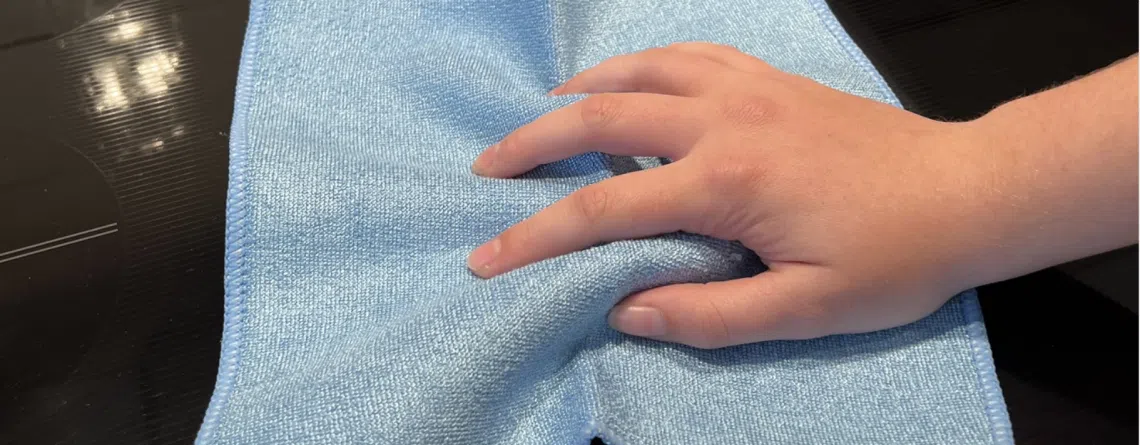
Microfiber and nonwoven wipers are both staple products in industrial and commercial cleaning programs, and they’re frequently confused or conflated. They’re manufactured differently, perform differently, and the right choice between them depends on your specific application, cleaning environment, and cost constraints. Understanding the distinction helps procurement managers, facility managers, and industrial buyers make the right specification decision rather than defaulting to whatever was ordered last.
How Microfiber Wipers Are Made
Microfiber is a textile — woven or knit from ultra-fine synthetic fibres, typically polyester and polyamide (nylon) split fibres under 1 denier in diameter. The fineness of the fibres creates a large surface area relative to the cloth’s weight, and the split fibre structure creates a mechanical cleaning action that picks up and traps particulates, oils, and bacteria without chemical assistance. Microfiber cloths can be laundered and reused hundreds of times before performance degrades.
Key microfiber characteristics: Very high absorbency (typically 6–8x the cloth’s weight in water), streak-free cleaning on smooth surfaces, excellent mechanical particulate capture, reusable, and effective for chemical-free surface sanitizing in some healthcare applications.
How Nonwoven Wipers Are Made
Nonwoven wipers are engineered fabrics — fibres (typically polyester, polypropylene, or rayon/viscose) bonded together by mechanical (spunlace), chemical, or thermal processes rather than weaving or knitting. The result is a disposable wiper in formats ranging from very light (DRC — dry, reusable cloth — polypropylene) to heavy (spunlace with high rayon content). Nonwovens are designed for single use and disposal, eliminating laundering cost and cross-contamination risk between uses.
Key nonwoven characteristics: Single-use (no cross-contamination between surfaces), consistent performance on every use, no laundering infrastructure required, available in lint-free formats for critical applications, and lower per-unit cost than microfiber for single-use applications.
Head-to-Head Comparison by Application
General Surface Cleaning (Offices, Counters, Desks)
Microfiber: Better mechanical cleaning, streak-free on glass and screens, ideal for daily use on consistent surfaces in a controlled environment.
Nonwoven: Single-use eliminates cross-contamination between surfaces — better for shared workspaces in high-occupancy environments.
Industrial Wiping (Machine Shops, Manufacturing)
Microfiber: Less appropriate — fine fibres can be damaged by rough surfaces and abrasive materials; reusability requires laundering contaminated cloths, which generates regulated wastewater with oil or chemical content.
Nonwoven: The standard for industrial wiping — oil-absorbent, lint-controlled, and disposable. Polypropylene nonwovens resist chemicals; rayon/polyester spunlace provides higher absorbency for coolant and solvent cleanup.
Healthcare and Cleanroom
Microfiber: Used in healthcare for environmental surface cleaning with appropriate disinfectants; colour-coded systems prevent cross-contamination between patient rooms and common areas.
Nonwoven: Preferred in ISO-classified cleanrooms where consistent lint control is mandatory — laundered microfiber can release fibres; validated sterile nonwoven wipers provide defined performance.
Food Service and Commercial Kitchen
Microfiber: Good for food-safe surface cleaning; colour-coded systems separate food contact surfaces from non-food-contact.
Nonwoven: Preferred where single-use is required for sanitation reasons and where laundering infrastructure is not available.
Glass and Reflective Surfaces
Microfiber: Clear winner — streak-free performance is a core microfiber advantage. Split fibres trap oils from glass without leaving residue.
Nonwoven: Can leave lint on glass surfaces; specialized low-lint nonwoven formats exist but are more expensive than microfiber for this application.
Cost Comparison
The cost comparison depends heavily on reuse cycles. Microfiber cloths typically cost $2–6 each and can be laundered 200–500 times before performance degrades — putting per-use cost at $0.01–0.03. Nonwoven wipers cost $0.05–0.50 per wiper depending on weight and format, with no laundering cost. For high-volume single-use applications (industrial wiping, food service), nonwovens are cost-competitive or cheaper when laundering overhead is factored in. For applications requiring daily wiping of the same surfaces in a controlled environment, microfiber’s reusability provides clear cost advantage over time.
The Right Choice by Industry
- Manufacturing and industrial: Nonwoven wipers for production and maintenance areas; microfiber for office and common area cleaning
- Healthcare: Both — microfiber for environmental cleaning programs; nonwoven for sterile applications and cleanrooms
- Food service: Microfiber colour-coded systems for most surface cleaning; nonwoven for high-sanitation single-use applications
- Commercial office: Microfiber for daily surface cleaning; nonwoven for restroom and high-traffic single-use areas
- Construction and remediation: Nonwoven — the environment is too rough for microfiber, and single-use prevents contamination carry-over
Source Wipers in Canada
Wi-Supply supplies nonwoven wipers and cotton cleaning cloths to Canadian businesses from Canadian inventory. We supply by the case and by the pallet for operations with regular consumption. Contact us for wholesale pricing and to discuss which wiper specification is right for your application.

